
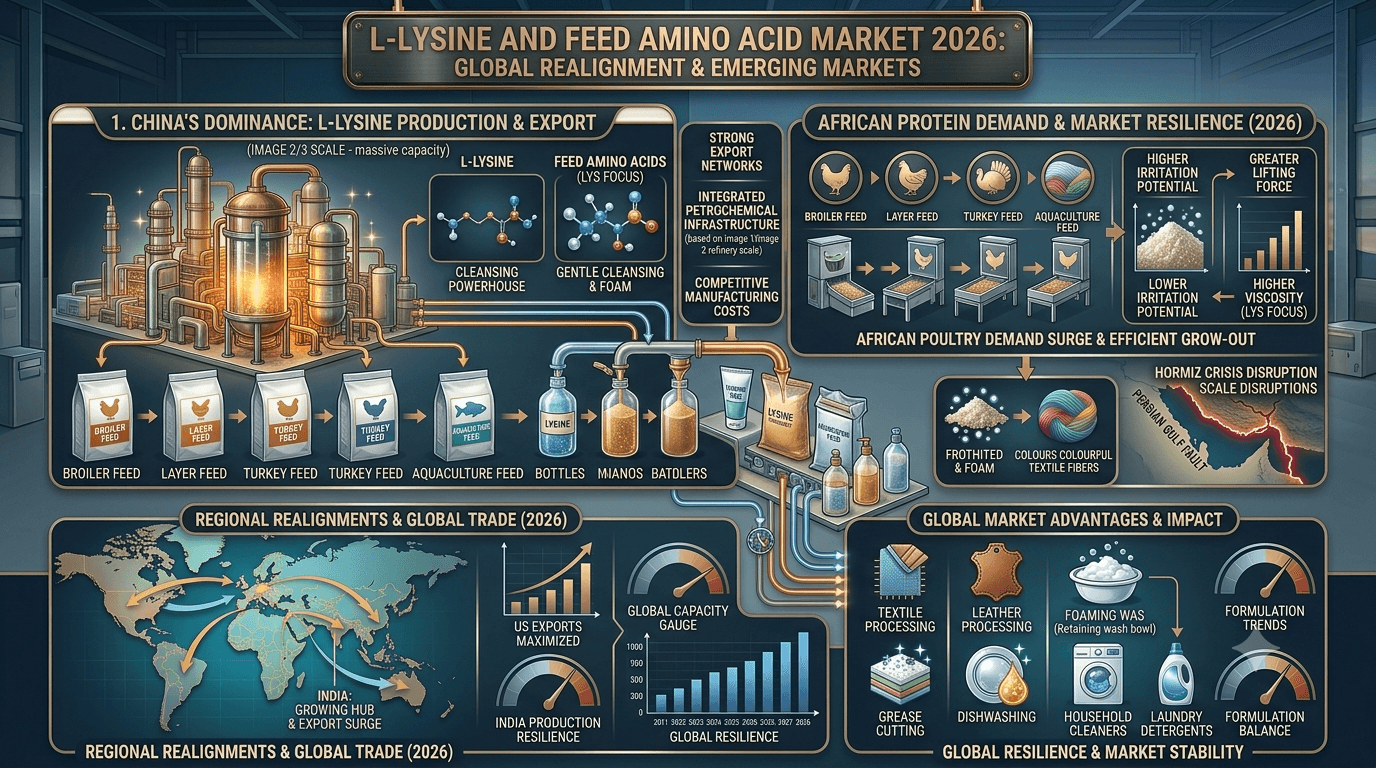
L-Lysine and Feed Amino Acid Market 2026: China's Dominance and African Protein Demand
Overview
L-lysine is the world's highest-volume feed amino acid and one of the most important nutritional supplements used in modern animal feed. It is primarily added to swine and poultry diets to improve growth performance and optimize protein utilization. By supplementing lysine, feed manufacturers can reduce the amount of expensive protein ingredients such as soybean meal while maintaining animal productivity.
As global demand for meat and poultry continues to grow, L-lysine remains a cornerstone of the livestock nutrition industry.

What Is L-Lysine?
L-lysine is an essential amino acid that animals cannot synthesize in sufficient quantities. It must therefore be supplied through feed.
Key benefits include:
Improved feed conversion efficiency
Enhanced animal growth rates
Reduced feed costs
Better protein utilization
Lower nitrogen emissions from livestock production
Reduced dependence on high-protein feed ingredients
Because lysine is often the first limiting amino acid in swine and poultry diets, supplementation is critical for optimal performance.
L-Lysine HCL CAS: 657-27-2
How L-Lysine Is Produced
Unlike DL-methionine, which is chemically synthesized, lysine is primarily produced through microbial fermentation.
The typical production process is:
Corn → Corn Starch → Glucose → Fermentation → L-Lysine
Key raw materials include:
Corn
Glucose syrup
Nutrient media
Fermentation microorganisms
Energy and processing inputs
This production method makes lysine economics closely linked to grain markets, particularly corn prices.
China's Dominance in Global Supply
China is the undisputed leader in the global lysine industry. Together, China and Indonesia account for more than 80% of global production capacity.
Several factors support this dominance:
Large corn-processing industries
Extensive fermentation infrastructure
Economies of scale
Competitive production costs
Strong export capabilities
As a result, global lysine prices are heavily influenced by production trends and policy decisions in Asia.
Major Producers
Leading manufacturers include:
Meihua Holdings
COFCO Biochemistry
Global Bio-chem Technology Group
Eppen Biotech
These companies supply feed manufacturers across Asia, Africa, Europe, and the Americas.

Impact of the Middle East Conflict
The 2026 Middle East conflict created temporary challenges for the feed amino acid sector despite lysine being produced primarily in Asia.
Key impacts included:
Disruptions to international grain shipping routes
Higher freight and logistics costs
Greater uncertainty in corn procurement
Volatility in soybean meal markets
Supply chain adjustments by fermentation producers
Although major lysine production facilities continued operating, sourcing and transportation became more complex for some manufacturers and exporters.
Major Commercial Forms
Two principal lysine products dominate international trade.
L-Lysine HCL 98.5%
Characteristics:
High purity
Consistent amino acid concentration
Widely used in commercial feed formulations
Preferred for precise nutritional balancing
L-Lysine Sulphate
Characteristics:
Lower lysine concentration than HCL grades
Contains additional nutritional components
Often used where cost efficiency is prioritized
Popular in large-scale livestock operations
Both grades are actively traded on international B2B chemical and feed ingredient platforms with specific formulation and quality requirements.
Demand Growth in Africa and Southeast Asia
The strongest long-term growth opportunities for lysine are emerging from developing livestock markets.
Key demand drivers include:
Africa
Expanding poultry production
Rising protein consumption
Commercialization of livestock farming
Population growth
Increasing demand for affordable animal protein
Southeast Asia
Rapid urbanization
Growing middle-class populations
Expansion of integrated poultry operations
Modernization of feed manufacturing
Increasing meat consumption
These regions are expected to remain among the fastest-growing consumers of feed amino acids over the coming decade.
Sustainability Benefits
L-lysine contributes to more sustainable livestock production by allowing lower crude-protein diets.
Benefits include:
Reduced soybean meal usage
Lower feed costs
Improved nutrient efficiency
Reduced nitrogen excretion
Lower environmental impact from livestock farming
As sustainability becomes increasingly important, amino acid supplementation is expected to play an even greater role in feed formulation strategies.
Market Outlook
The L-lysine market in 2026 continues to be shaped by China's dominant production capacity, grain market dynamics, and expanding global demand for animal protein. While logistical disruptions and feedstock volatility may create short-term price fluctuations, long-term growth remains supported by increasing poultry and swine production, particularly in Africa and Southeast Asia.
Key Takeaways
L-lysine is the world's highest-volume feed amino acid.
It helps reduce soybean meal usage and improve feed efficiency.
China and Indonesia account for more than 80% of global production.
Major producers include Meihua Holdings, COFCO Biochemistry, Global Bio-chem, and Eppen Biotech.
Grain shipping disruptions created temporary sourcing challenges in 2026.
L-Lysine HCL 98.5% and L-Lysine Sulphate are the main commercial grades.
African and Southeast Asian poultry industries are major long-term demand drivers.