Introduction: The Ubiquitous Sweetener and the Humidity Challenge
Within the global food, beverage, and pharmaceutical industries, few ingredients are as foundational and universally utilized as Dextrose Monohydrate. As a highly purified, crystallized form of D-glucose derived from the enzymatic hydrolysis of starch, it serves as a primary energy source, a mild sweetener, a fermentation substrate, and a highly effective bulking agent. From sports hydration powders and baked goods to intravenous medical solutions and confectionery glazes, its applications are practically limitless. Because of its massive consumption volume, procurement teams often classify Dextrose Monohydrate as a stable, baseline commodity.
However, treating Dextrose Monohydrate as a passive, indestructible white powder is a critical logistical error, particularly when operating within the tropical and equatorial zones. In regions characterized by sustained high temperatures and relentless relative humidity, the physical stability of this carbohydrate becomes the primary operational bottleneck. The supply chain for Dextrose Monohydrate in a humid climate is a constant battle against thermodynamics. If left unmanaged, the ambient environment will fundamentally alter the physical state of the ingredient long before it reaches the manufacturing blending vat. For the strategic procurement manager, the warehouse director, and the Quality Assurance team, understanding the precise moisture dynamics of this molecule is essential to preventing massive inventory write-offs, catastrophic factory downtime, and compromised final products.
The Molecular Water of Crystallization: Why "Monohydrate" Matters
To master the logistics of Dextrose, one must first understand its distinct chemical architecture. Commercially, dextrose is available in two primary forms: Anhydrous and Monohydrate. The vast majority of the food industry relies on the Monohydrate form due to its favorable economics and specific functional properties during mixing and baking. The term "Monohydrate" is not merely a naming convention; it defines the molecule's physical state. During the industrial crystallization process, as the glucose comes out of the concentrated syrup solution, each individual molecule of D-glucose chemically binds with exactly one molecule of water. This is known as the water of crystallization.
This bound water constitutes approximately eight to nine percent of the total weight of the powder. Under optimal, temperature-controlled conditions, this water is locked rigidly within the crystal lattice, and the product behaves as a perfectly dry, free-flowing powder. However, this internal moisture makes the crystal structure highly sensitive to external thermal and atmospheric fluctuations. If the ambient temperature inside a shipping container or a warehouse spikes too high, the crystal lattice begins to destabilize, and the bound water can be released, turning the powder into a sticky, unworkable mass. Conversely, its structure also dictates how it interacts with external humidity, setting the stage for the most common supply chain failure: caking.
Hygroscopicity and the Caking Threshold: The Tropical Threat
The greatest threat to Dextrose Monohydrate in a humid climate is its inherent hygroscopicity, which is the tendency of a solid substance to absorb moisture directly from the surrounding air. Every powdered ingredient has a critical relative humidity threshold. When the ambient humidity in a warehouse exceeds this specific threshold, the powder transitions from being physically stable to actively pulling water vapor out of the atmosphere. For Dextrose Monohydrate, the danger zone typically begins when ambient relative humidity consistently exceeds sixty to sixty-five percent. In tropical climates, where the humidity frequently hovers between seventy-five and ninety percent during the wet season, the environment is highly hostile to the unprotected powder.
When Dextrose Monohydrate absorbs this external moisture, a microscopic, destructive chain reaction occurs. First, surface dissolution takes place as moisture condenses on the exterior of the individual dextrose crystals, causing the outermost layer of the sugar to dissolve and form a highly concentrated, sticky syrup. Next, liquid bridging occurs as pallets of the powder are stacked upon one another. The immense physical pressure forces these sticky crystals together, with the syrup acting as a glue that forms liquid bridges between millions of individual particles. Finally, if the temperature drops or the ambient humidity slightly decreases, these liquid bridges dry out and recrystallize. The individual free-flowing particles are now permanently fused together into a solid, rock-hard block, which is the phenomenon universally known as caking.
For the factory operator, caked Dextrose Monohydrate is an operational nightmare. A solid twenty-five-kilogram brick of dextrose cannot be poured into a blending tank. It must be manually smashed with mallets or run through heavy-duty industrial grinders before use. This drastically slows down batch cycle times, damages automated augers and pneumatic conveying lines, and introduces a severe risk of foreign material contamination from torn bags or broken grinding equipment. Furthermore, the added moisture throws off the precise weight-based formulations required by the research and development department, potentially altering the water activity of the final food product and reducing its shelf life.
Packaging Engineering: The First Line of Defense
Because the supply chain cannot control the weather outside, it must engineer an impenetrable micro-climate around the product. For procurement managers, sourcing Dextrose Monohydrate for humid regions requires an uncompromising approach to packaging specifications. A cheap bag will inevitably lead to expensive product losses, as standard, single-layer woven polypropylene sacks are entirely inadequate for protecting hygroscopic sugars from tropical humidity. The packaging must act as a fortress against moisture vapor transmission.
The required industrial standard is a highly engineered, multi-wall system that attacks moisture from multiple angles. The outer barrier of the bag must utilize high-strength, multi-ply Kraft paper to provide excellent structural rigidity, allowing the bags to be stacked securely on pallets without slipping or tearing during transit. Beneath this, the absolute critical component is the inner moisture shield, typically a thick, high-density polyethylene or linear low-density polyethylene liner that provides the primary defense against atmospheric moisture. Finally, the procurement team must ensure that the manufacturer employs a rigorous sealing process for this liner. If the inner liner is simply folded over and stitched alongside the Kraft paper, the microscopic holes created by the sewing needle will act as moisture tunnels. Therefore, the plastic liner must be completely heat-sealed or ultrasonically welded shut before the outer bag is closed.
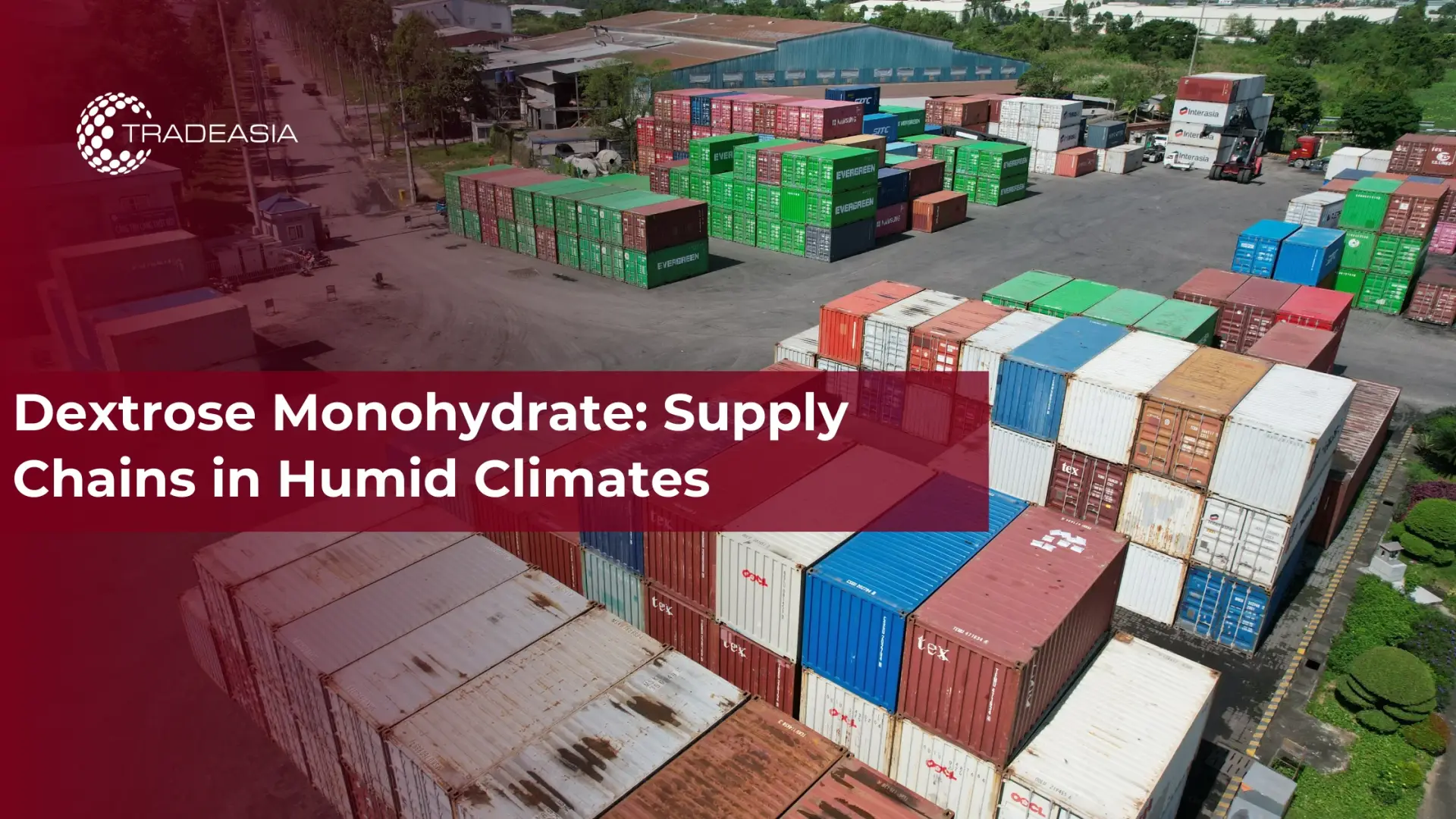
Additionally, the physical preparation of the pallet is vital. Pallets must be entirely encapsulated in heavy-duty stretch wrap. In severe logistical scenarios, utilizing a polyethylene shrink-hood over the entire pallet provides an unbroken barrier that protects the powder from the violent condensation cycles, often called container sweat, that occur during ocean freight crossing the equator.
Warehouse Climate Control: Mitigation Beyond the Pallet
Even with flawless packaging, Dextrose Monohydrate cannot survive indefinitely in a hostile storage environment. The logistics and warehousing teams must implement strict physical protocols to mitigate the risk of thermal shock and moisture ingress once the material is received at the factory. First, standard warehousing geometry must be respected. Pallets of Dextrose Monohydrate must never be placed directly on the concrete floor, nor should they be pushed flush against exterior warehouse walls. Concrete and external walls act as thermal bridges, easily transferring moisture and heat directly into the product. A minimum clearance of fifty centimeters from walls and the strict use of dry, intact wooden or plastic pallets are non-negotiable best practices.
Secondly, facility managers must balance cross-ventilation with climate control. In highly humid regions, leaving warehouse bay doors open for fresh air often does more harm than good, as it constantly introduces saturated, moist air into the storage area. If full air-conditioned climate control is economically unfeasible for the bulk raw material warehouse, the facility must deploy heavy-duty industrial dehumidifiers and high-volume, low-speed ceiling fans to keep the air moving and prevent stagnant, localized pockets of extreme humidity from settling around the stacked sugar.
The Procurement Strategy: Lead Times and Inventory Rotation
The physical realities of Dextrose Monohydrate dictate that procurement strategy cannot rely solely on bulk, long-term purchasing to secure price breaks. The longer the powder sits in a humid supply chain, the higher the probability of catastrophic caking. Procurement must shift from a static purchasing model to a dynamic, velocity-driven strategy. Smart procurement in tropical zones requires mastering inventory velocity. The goal is to synchronize inbound shipments perfectly with production consumption, minimizing the dwell time of the raw material in the warehouse. This just-in-time methodology drastically reduces the window of opportunity for moisture absorption.
Furthermore, procurement and quality assurance teams must enforce absolute discipline regarding first-in, first-out inventory management. Lot tracking must be impeccable. If an older pallet of Dextrose Monohydrate is buried behind newer stock and left to endure multiple cycles of daytime heat and nighttime humidity, it is virtually guaranteed to cake.
Finally, strategic sourcing involves auditing the manufacturer's capabilities. A high-quality supplier does not just crystallize the dextrose; they employ advanced, multi-stage fluid bed dryers and cooling systems to ensure the powder is brought down to a stable temperature and a precise moisture content before it is sealed in the bag. Packaging hot dextrose traps latent heat and moisture inside the liner, guaranteeing caking during transit. Procurement must demand transparency into the supplier's cooling parameters before committing to high-volume contracts.
Conclusion
Dextrose Monohydrate is a critical engine of the global food and pharmaceutical industries, offering exceptional functionality, sweetening power, and economic value. However, its molecular structure and inherent hygroscopicity make it highly vulnerable to the relentless heat and moisture of tropical and equatorial supply chains. Treating it as a simple, inert commodity is a recipe for operational failure. By prioritizing advanced, high-barrier packaging engineering, maintaining rigorous warehouse climate control protocols, and executing a high-velocity, inventory-driven procurement strategy, supply chain professionals can neutralize the threat of caking. Protecting the physical stability of Dextrose Monohydrate ensures that manufacturing lines run smoothly, product formulations remain precise, and the end consumer receives the flawless quality they expect.
Partner with Food Additives Asia for Supply Chain Security
The efficiency and consistency of your production line depend entirely on the physical integrity and flowability of your raw materials. At Food Additives Asia, our distribution network specializes in navigating complex logistical environments to provide uninterrupted access to premium, physically stable food ingredients. We focus on utilizing advanced, export-grade multi-wall packaging featuring heat-sealed, high-barrier moisture liners to ensure your Dextrose Monohydrate survives challenging transit routes and domestic storage without caking.
Furthermore, we provide comprehensive Certificates of Analysis from accredited manufacturers, guaranteeing absolute adherence to purity standards, precise moisture content, and optimal particle size distribution. By ensuring consistent availability and transparent communication regarding inventory velocity, we allow your procurement operations to plan effectively and mitigate environmental risks. Secure your functionality and prepare for efficiency. Contact our team at foodadditivesasia.com to discuss your Dextrose Monohydrate specifications and customized supply chain strategies.