Introduction: The Thermal Challenge in Traditional Snack Coatings
The commercial production of traditional Asian snacks, ranging from glazed rice crackers and deep-fried dough twists to modern extruded puffed snacks, relies heavily on complex, multi-layered flavor profiles. These products demand a precise equilibrium of sweet, savory, and umami notes to drive consumer palatability. However, imparting a stable sweetness into these specific snack matrices presents a formidable thermodynamic challenge for the formulation engineer. The manufacturing processes involved, specifically deep-fat frying and high-temperature, high-shear extrusion, create incredibly hostile thermal environments that readily destroy conventional sweetening agents. To overcome these industrial hurdles and maintain strict profit margins, commercial snack manufacturers consistently rely on Sodium Saccharin as their primary high-intensity sweetener. Understanding the thermal resilience and functional economics of this highly stable additive is essential for any food scientist or procurement director operating within the high-volume savory snack sector.
The Physics of Deep-Frying: Why Sucrose and Aspartame Fail
The fundamental obstacle in coating deep-fried snacks is the Maillard reaction and the process of caramelization. When manufacturers attempt to glaze a product with standard sucrose or high-fructose corn syrup prior to or immediately after frying, the sugars are exposed to oil temperatures frequently exceeding 180°C. At these extreme temperatures, reducing sugars rapidly caramelize, turning from a desirable golden-brown to a bitter, burnt carbon layer in a matter of seconds. Furthermore, modern alternative sweeteners like Aspartame are completely unsuited for this application, as their molecular bonds irrevocably break down under sustained heat, resulting in a total loss of sweetening power.
Sodium Saccharin circumvents these thermal limitations entirely. Because it is a non-caloric, synthetically derived compound, it does not participate in the Maillard reaction and exhibits exceptional chemical inertness. It can withstand the intense, prolonged heat of an industrial frying vat without degrading, discoloring, or losing its intense sweetening capacity. This physical reality ensures the final snack retains its intended flavor profile and visual aesthetic from the factory floor all the way to the retail shelf.
Extrusion Dynamics: Surviving High-Shear Environments
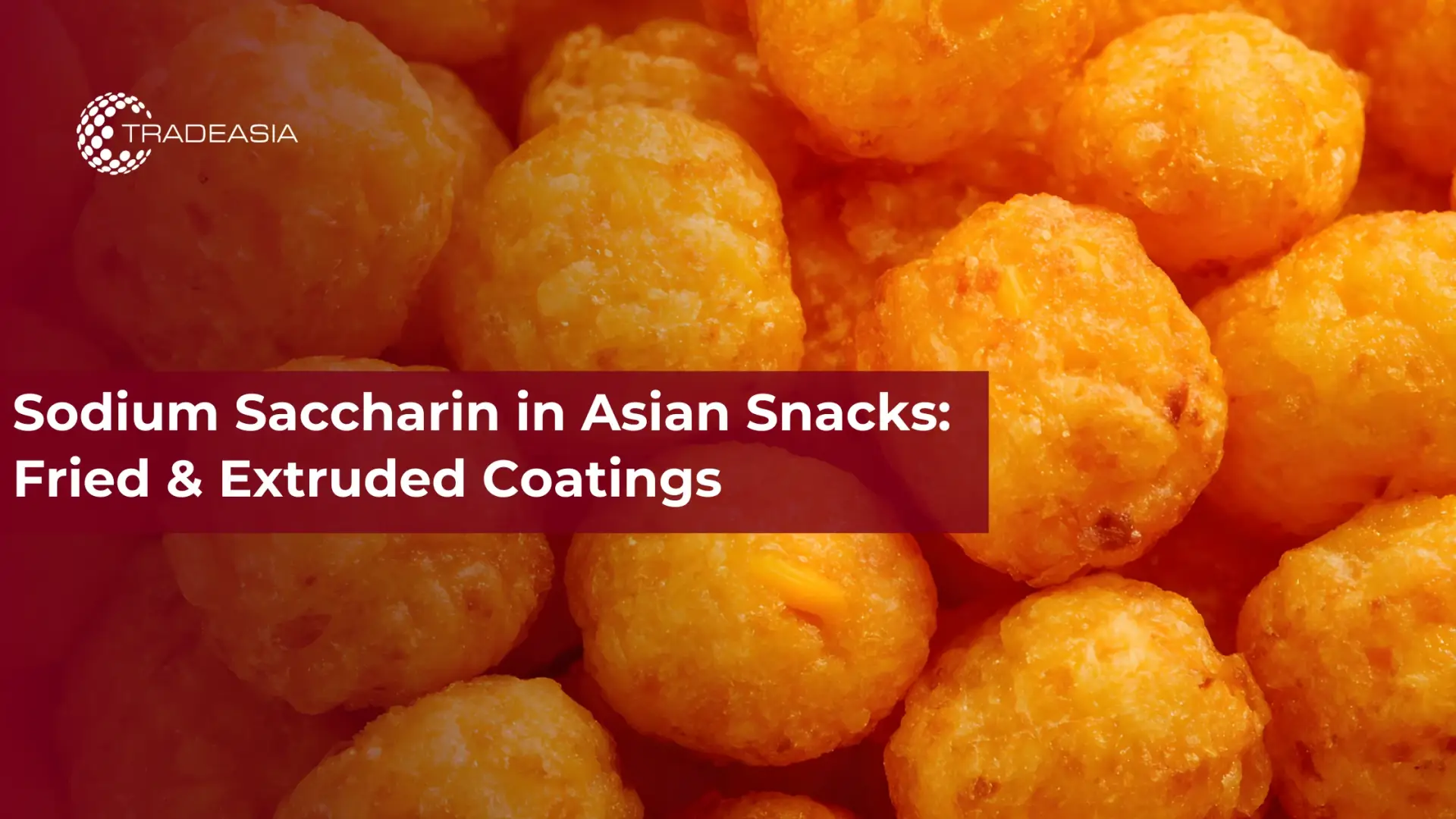
Beyond traditional deep-frying, the Asian snack market is heavily driven by extruded products, such as puffed corn or tapioca-based snacks. The twin-screw extrusion process subjects the raw carbohydrate matrix to massive mechanical shear, immense atmospheric pressure, and intense localized friction heat before the product expands through the die. If a sweetening agent is incorporated directly into the dough matrix prior to extrusion, it must survive this brutal mechanical journey.
Sodium Saccharin is uniquely qualified for this internal formulation strategy. Its robust crystalline structure remains completely intact despite the intense physical and thermal stresses of the extruder barrel. By dosing the sweetener directly into the base matrix rather than relying entirely on topical post-extrusion slurries, formulators achieve a more homogenous flavor distribution throughout the puff, preventing the sweetness from flashing off or becoming localized exclusively on the exterior coating. This internal stability allows for highly consistent flavor delivery in every single bite.
Organoleptic Synergy: Balancing Sweet, Salty, and Umami Profiles
In the context of Asian snack profiles, sweetness is rarely intended to be the dominant, solitary flavor note. Instead, it serves as a critical background enhancer, designed to elevate complex savory elements like soy sauce, chili powder, seaweed, or monosodium glutamate. When utilizing a high-intensity sweetener, the sensory challenge is preventing a lingering metallic or intensely artificial aftertaste. While pure Sodium Saccharin can present a slight bitter off-note at very high concentrations, the minimal dosage required in savory snack coatings falls well below this threshold.
Furthermore, food scientists leverage its exceptional blending capabilities. Sodium Saccharin exhibits profound synergistic effects when combined with savory flavor enhancers and dietary salts. The presence of sodium chloride naturally masks the synthetic aftertaste of the saccharin, while the saccharin simultaneously softens the harshness of the salt and chili, creating the highly addictive, perfectly balanced organoleptic profile that drives continuous consumer snacking behavior.
The Procurement Perspective: Cost-in-Use and Margin Optimization
For the strategic procurement manager overseeing a high-volume snack manufacturing facility, raw material economics dictate the viability of the entire product line. The snack food industry operates on razor-thin profit margins, making cost-in-use the ultimate metric for ingredient selection. Sodium Saccharin represents an unparalleled financial advantage in this arena. Because it is approximately three to four hundred times sweeter than standard sucrose, the required volumetric dosage is infinitesimally small.
A single kilogram of Sodium Saccharin can replace hundreds of kilograms of bulk sugar in a topical coating slurry or extrusion matrix. This massive reduction in raw material volume translates into profound logistical savings, drastically reducing the required warehouse footprint, lowering inbound freight costs, and insulating the manufacturer from the extreme price volatility of the global sugar commodity market. By transitioning to this high-intensity sweetener, procurement teams can significantly lower the bill of materials cost while maintaining the exact sensory profile demanded by the consumer base.
Quality Assurance: Sourcing FCC Food-Grade Sodium Saccharin
Securing the functional and financial benefits of Sodium Saccharin requires a rigorous approach to quality assurance and vendor qualification. Procurement directors cannot simply purchase generic industrial-grade saccharin; they must ensure absolute compliance with global food safety standards. The buyer must specify material that strictly adheres to the Food Chemicals Codex or relevant regional food-grade monographs.
The critical parameters evaluated by the quality assurance team include absolute purity, the total absence of heavy metal contamination, and strict limits on trace manufacturing impurities such as toluenesulfonamides, which can introduce unwanted chemical off-tastes and trigger severe regulatory rejections. Furthermore, the procurement team must precisely specify the physical form of the additive, choosing the appropriate mesh size or crystalline structure to ensure rapid dissolution in the coating slurry or homogenous dry-blending in the extrusion premix. Partnering with transparent, heavily audited supply chains is the only way to guarantee this functional precision and food-safe regulatory compliance.
Conclusion
The production of traditional and modern Asian snacks demands raw materials capable of surviving some of the most hostile processing environments in the food industry. Attempting to impart stable sweetness into deep-fried or extruded matrices using conventional sugars or heat-sensitive artificial sweeteners inevitably leads to caramelized off-flavors, visual defects, and massive material waste. Sodium Saccharin stands as the definitively superior sweetening agent for these complex industrial applications. Its absolute thermal resilience prevents degradation in the frying vat, its structural stability survives the intense shear of the extruder, and its unparalleled cost-in-use metrics provide massive financial leverage for the procurement team. By strategically sourcing premium food-grade Sodium Saccharin, formulation engineers and supply chain directors can optimize their manufacturing efficiency, protect their profit margins, and deliver the perfectly balanced, intensely flavorful snacks that dominate the retail market.
Partner with Food Additives Asia for Ingredient Security
The consistency of your traditional snack portfolio and the integrity of your brand's flavor profile depend entirely on the thermal stability of your sweetening systems. At Food Additives Asia, we supply premium, high-assay Sodium Saccharin specifically engineered to meet the rigorous high-heat and high-shear demands of the global savory snack and extrusion industry. We focus on uncompromising purity, sourcing strictly food-grade materials with near-zero trace impurities to ensure maximum sweetening power without introducing metallic off-flavors or chemical aftertastes to your delicate seasoning blends. We drive operational excellence by providing specialized, free-flowing crystalline formats designed for rapid dissolution in coating slurries and flawless dry-blending in high-speed automated lines. Furthermore, we guarantee supply chain security by ensuring consistent, year-round availability from fully audited, top-tier global manufacturers, completely insulating your high-volume production from market volatility and logistical disruptions. Secure your flavor profile and protect your profit margins by contacting us today for Sodium Saccharin specifications, technical dosing guidelines, and reliable forward contracting options at foodadditivesasia.com.